
GJO & Partners | Economic and financial intelligence
Cameroon Weekly Capital Brief
Issue 04 · Special report
· Information as of 6 November 2026
Ten years of investment: which sectors attract capital across Cameroon’s ten regions?
Ports, energy, agricultural processing and urban markets: documented major projects reveal an economic geography that can guide investment selection.
Context
In our previous issue, we examined three drivers of profitability in Cameroon: banking, telecommunications and agribusiness. A further question follows: where is capital being deployed across the country?
A cement plant in Figuil, a cocoa factory in Kékem and a port terminal in Kribi respond to different economic conditions. Their locations provide information about available resources, markets served and the infrastructure required for production.
We reviewed publicly documented major projects across the ten regions between 7 November 2016 and 6 November 2026. Our interpretation identifies three anchors: access to ports and energy, proximity to raw materials, and demand from urban markets.
This mapping is a documentary selection. It provides a partial picture of regional investment: SMEs, private real estate and undisclosed spending are particularly underrepresented. Figures refer to project costs or identified financing; some projects started before the review period. Their full budgets therefore differ from expenditure incurred during these ten years.
Facts
1. Littoral, South and Centre: industry, infrastructure and large markets
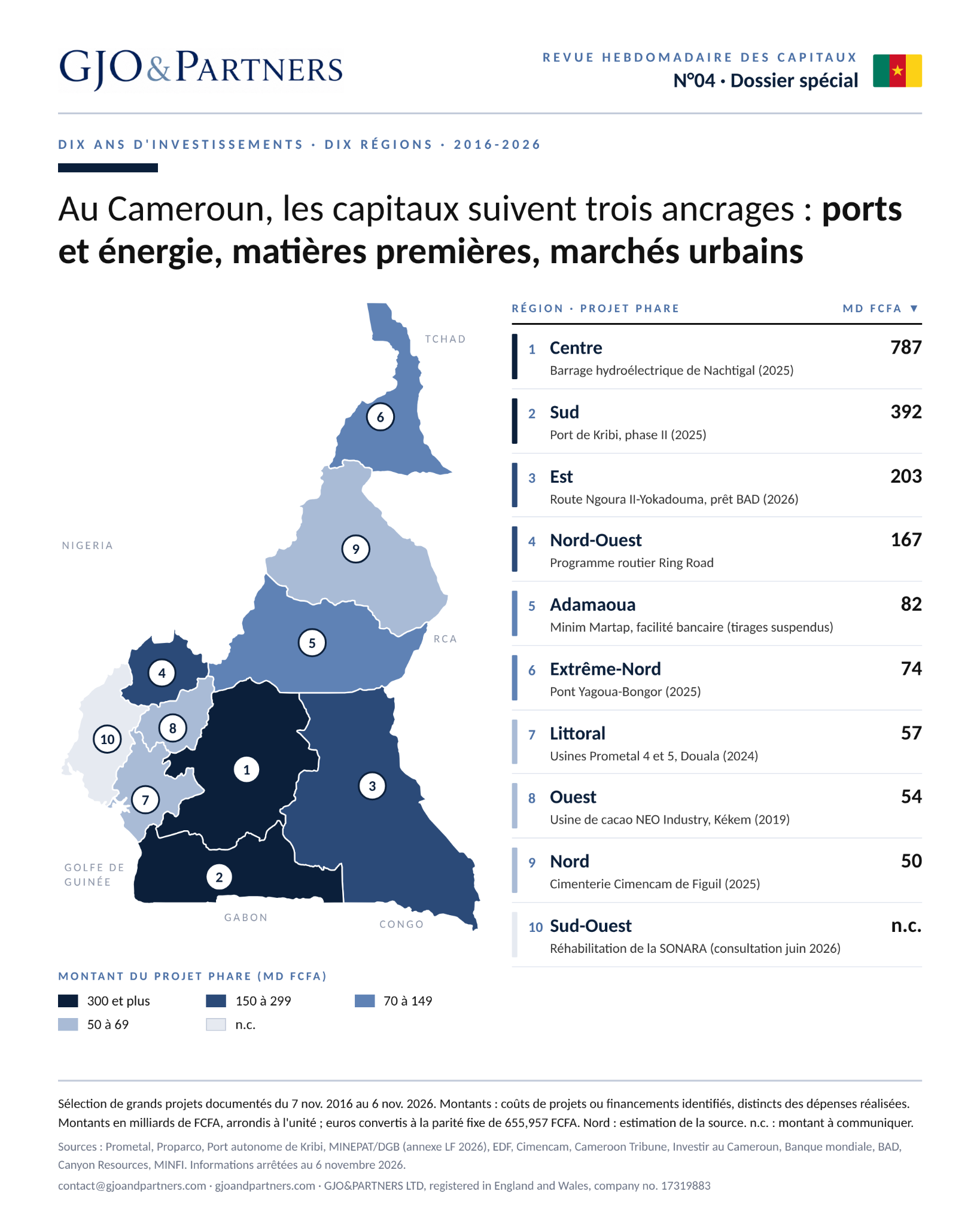
In Littoral, Prometal 4 and 5, inaugurated in Douala in January 2024, represent an announced investment of CFAF 57 billion. ProAlu extends this industrial development: in September 2025, Proparco reported a project budget of EUR 140.3 million, equivalent to approximately CFAF 92 billion, financed through 58% debt and 42% equity. This budget differs from an amount fully disbursed.
In the South, the Kribi port extension entered operation on 9 May 2025. The annex to the 2026 Finance Law records a cost of CFAF 391.5 billion for phase II. The hub also hosts cocoa, cement and ceramics manufacturers. One example illustrates the complementarity between energy and production: SNH reports building a CFAF 7.2 billion gas pipeline to supply Keda Ceramics in 2024. This figure covers the pipeline alone.
In the Centre, Nachtigal has a total project cost of EUR 1.2 billion, approximately CFAF 787 billion. EDF dates its full commissioning to March 2025. Near the Yaoundé market, Cimencam also inaugurated its Nomayos factory in 2019, following an investment of approximately CFAF 28 billion.
Sources: Prometal, Proparco — ProAlu, Port autonome de Kribi, MINEPAT/DGB — grands projets, annexe LF 2026, SNH — gaz industriel, MINEPAT — Nachtigal, EDF, Cimencam — Nomayos.
2. West, North and Far North: processing resources and securing trade
In the West, NEO Industry’s Kékem factory, inaugurated in April 2019, represents a published investment of CFAF 54 billion in cocoa processing. In Bafoussam, a new SABC production line, operational from December 2024 according to the economic press, required CFAF 13 billion.
In the North, Cimencam inaugurated its new cement and clinker unit in Figuil in June 2025. The project is valued at approximately CFAF 50 billion, including CFAF 47 billion of syndicated bank financing signed in 2022. Alongside this, the World Bank approved a USD 200 million credit in 2020 for irrigation and agricultural production in the Bénoué Valley.
In the Far North, VIVA Logone benefits from a USD 200 million credit approved in 2021. PACRI, covering the Mora–Kousséri corridor and community resilience among other activities, secured USD 330 million in financing in 2023. The Yagoua–Bongor bridge, inaugurated in April 2025, represents CFAF 74 billion for the entire cross-border project, including access roads.
Sources: Cameroon Tribune — NEO Industry, Investir au Cameroun — SABC Bafoussam, source de presse, Cimencam — financement Figuil, Cimencam — inauguration, Banque mondiale — Bénoué, Banque mondiale — Logone, Banque mondiale — PACRI, Services du Premier ministre — pont Logone.
3. Adamawa, East, North-West and South-West: mining development, connectivity and recovery
In Adamawa, Minim Martap is bringing forward a new mining and logistics project. Its September 2025 feasibility study presents initial capex of USD 96 million. A separate CFAF 82 billion bank facility was signed. However, the quarterly report dated 30 October 2026 states that additional drawdowns were suspended and the first-shipment target had been withdrawn. Estimated capex and signed credit measure different things.
In the East, the African Development Bank approved a EUR 309.93 million loan in February 2026, approximately CFAF 203.3 billion, for the Ngoura II–Yokadouma road section. The Lom Pangar powerhouse reached its 30 MW capacity according to an update published in January 2024. The Mbalam iron ore project adds a mining prospect; the evidence reviewed remains insufficient to confirm actual exports as of 6 November 2026.
In the North-West, the Ring Road programme, initially estimated at CFAF 167.3 billion, illustrates the importance of improved connectivity. Its execution must be assessed section by section. In the South-West, the international market consultation held in June 2026 for SONARA’s rehabilitation illustrates a different objective: restoring an existing asset to production. MINFI specifies that the consultation was separate from a tender or contract award.
Sources: Canyon Resources — Minim Martap, Canyon — facilité bancaire, Canyon — rapport du 30 octobre 2026, reproduit par FinancialFilings, BAD — Ngoura II–Yokadouma, Cameroon Tribune — Lom Pangar, Cameroon Tribune — Mbalam, BAD — Ring Road, MINFI — SONARA.
Impact: how can investors use this geography?
Follow demand created by assets already financed
Our interpretation: infrastructure or a factory can create opportunities for other businesses. Around an industrial hub, these needs may involve transport, warehousing, maintenance, equipment and services for workers. Around an agricultural basin, they may involve collection, drying, storage and processing.
A major project therefore helps direct the search. An investment in a supplier must then stand on that supplier’s own contracts and margins.
Compare business models within the same territory
An agricultural region can host a building-materials industry, as Figuil illustrates. A cocoa-producing region can capture more value through processing, as in Kékem. Available resources, energy costs and accessible markets should be assessed together.
For an investor, the practical question is: which business can produce and deliver competitively to customers able to pay? Answering it requires examining operating expenditure, losses, inventories, collection periods and maintenance needs.
Match financing to the project’s actual stage
A business expanding an operating factory, a mine preparing its first shipment and an industrial company rebuilding an asset carry different risks. Equity, debt and repayment terms should reflect those differences.
Our recommendation is to select a business model and verifiable demand first, then test whether the location provides the conditions required to deliver. Public spending in a region alone provides insufficient evidence of a nearby private business’s profitability.
Key takeaways
- Documented major investments suggest several specialisations: industry and logistics in Littoral and Kribi; infrastructure and urban demand in the Centre; food processing in the West; irrigated agriculture and materials in the North; resilience and trade in the Far North. Other regions combine mining development, improved connectivity and industrial recovery to varying degrees. This interpretation reflects the reviewed projects rather than comprehensive sector shares.
- Opportunities can emerge around major assets. Transport, storage, maintenance and processing warrant examination when volumes, customers and contracts are established.
- Selection should connect location, business and financing. Access to resources and infrastructure, margins after all costs, future capital requirements and exit conditions remain decisive.
Considering an investment in Cameroon? GJO & Partners supports investors from strategy and opportunity selection through execution, monitoring and exit preparation. Discuss your project.
Regulatory disclaimer
Cameroon Weekly Capital Brief is an economic and financial information and analysis publication produced by GJO & Partners.
The information, analysis, opinions and projections in this publication are provided solely for general information. They do not constitute personalised investment advice, a recommendation to buy, sell or hold financial instruments, or an offer or solicitation relating to regulated financial products or services.
Analysis relies on public sources considered reliable at the publication date. GJO & Partners does not guarantee their completeness or accuracy. Opinions and forward-looking scenarios may change without notice.
Investment decisions remain the responsibility of the person making them, who should, where necessary, consult a duly authorised professional in the relevant jurisdiction.
© 2026 GJO & Partners. All rights reserved.